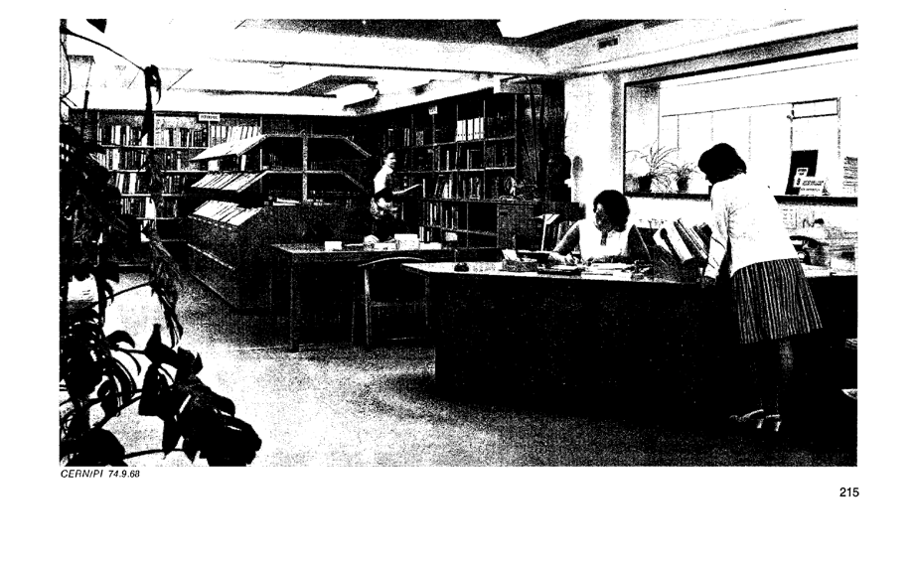
Tuesdays 10 o’clock was an important time for physicists working at CERN. Every week at that time, starting in the early 1960s, a ritual would play out that also structured much of the local research community’s habits of acquiring new information of what was happening in particle physics and related fields. As one informant who used to work for the Scientific Information Service at CERN described to me:
“A librarian would appear carrying a large pile of newly-received preprints, each one marked with its report number for subsequent filing. She would lay out the preprint one-by-one on the display on top of the wooden drawers where the back collection was stored, the preceding ones were taken away for copying in response to requests and later in the day filed. Each preprint had a small slip attached by a paper clip to the first page, on which one could give one’s name if one wanted to be sent a copy in the internal mail.”
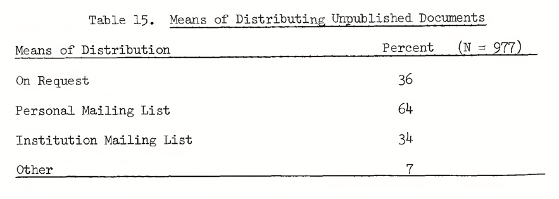
“Preprints” have served as an important means to rapidly inform members of the global physics community about the newest developments and findings in the field. Personal contact was essential to keep afloat of rapid developments until the 1940s, and the sharing of lecture notes, unpublished reports, or copies of manuscripts through the mail or at gatherings had considerable importance for members of the community. As historian David Kaiser notes: “No one could afford to rely on published sources alone.”1 That is, journal publications were extremely slow, due to the refereeing process and editorial treatments. Often, papers were only published many months (or years) after they had been submitted for publication and thus made vital information only available after considerable time lags. Physicist therefore cultivated their private mailing lists to know who to send their newest paper manuscripts to and whom to inquire for fresh information on research problems in the field. Authors would keep track of those researchers, who were active in the same research are or who could otherwise be interested in ones work. In a study of communication behaviors among high-energy theoretical physicists conducted for the American Institute of Physics and published in 1967, the authors reveal that the majority of scientists relied on these “personal mailing lists” to keep up with the newest developments in the field.2
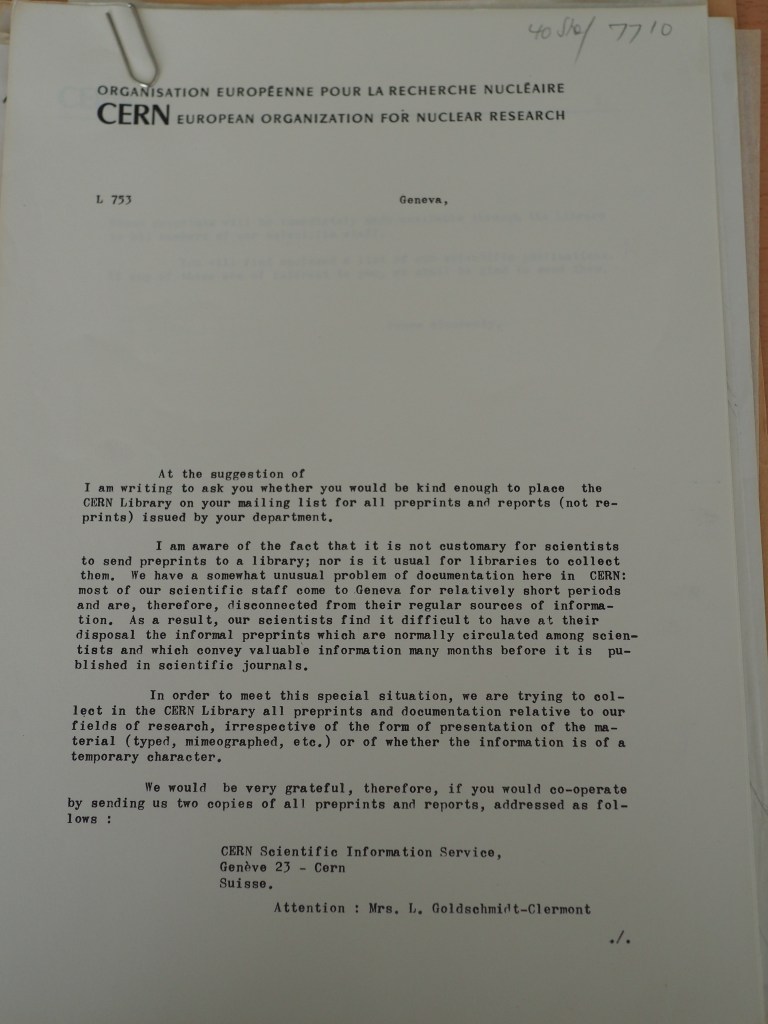
The library at CERN played a major role in the early developments of the preprint infrastructure in physics. In the late 1950s, the librarian Luisella Goldschmidt-Clermont ventured on a daring mission: She began soliciting preprints from physicists to collect and display at the library. Since the practice of sharing one’s notes or manuscripts was initially based on personal contacts, asking them to send their papers and notes to an institution was a breach in a system based on a convention of “private communication”. When Mrs. Goldschmidt-Clermont started asking physicists to not only send their unpublished papers to the CERN library to put on display for the local research community, but also asked to share their personal contacts with the institution, she was introducing radical changes into the communication behaviors of high-energy physicists. The CERN library justified this unusual innovation with “problems of documentation.” In a letter sent to roughly 600 physics institutes and laboratories around the world it reads: “most of our scientific staff come to [the laboratory in] Geneva for relatively short periods and are, therefore disconnected from their regular sources of information.” These sources were, of course, the private mailing networks, which were anchored in a researchers home institution.
While it was unconventional to request that physicists send their preprint papers to the library instead of directly to their network of colleagues, the local physicists, with whom Goldschmidt-Clermont spoke, were enthused and showed support for her project; the higher echelons at the CERN library voiced concern that her preprint system might distort the mechanisms for making claims to priority in science, which is usually registered through formal publication in a scientific journal. Although physicists acknowledge that a public preprints registry at the CERN library “would help to disclose real issuance dates,” Goldschmidt-Clermont took recourse to the one argument that couldn’t be denied to justify the new practice: the mandate of CERN.3 In a proposal to the directorate in 1961 to set up the preprint collection and distribution system, she therefore emphasized the “openness” policies that were enshrined into the founding of CERN:
“… CERN’s contribution to this [preprint system] is intended mostly as a ‘conversion’ of its present efforts in the field of preprints towards this project. CERN would benefit directly form this conversion as more material would become available to its scientists. CERN would also benefit indirectly from this conversion; by an inexpensive gesture of good will, it would share with the Member States laboratories a privilege (the preprint service) which CERN is almost alone to enjoy at present in Europe; by its Convention, CERN is bound to contribute to ‘international cooperation in nuclear research, … This cooperation may include … the promotion of contacts between … scientists, the dissemination of information, …’ (CERN Convention, Article II, para 3 c)”
Thus, it could be argued that the CERN library is where important groundwork for the current culture of “open science” was laid in the 1960s, by establishing a public information infrastructure for preprints.
- David Kaiser (2005). Drawing Theories Apart. The Dispersion of Feynman Diagrams in Postwar Physics. Chicago/London: University of Chicago Press. ↩︎
- Miles A. Libbey, Gerald Altman (1967). The Role and Distribution of Written Informal Communication in Theoretical High Energy Physics. New York: American Institute of Physics. ↩︎
- Phillip H. Roth (2026). Formalizing Informal Communication: An Archaeology of the Early Pre-Web Preprint Infrastructure at CERN. Minerva. https://doi.org/10.1007/s11024-026-09639-w ↩︎

