Moderation is vital on preprint servers like arXiv.org. Today, more than ever, moderators are experiencing immense pressure due to the rising number of AI slop papers. Moderation is usually described as the screening of submitted papers to assess whether they meet formal scholarly criteria and are of at least minimal interest to a specialized community served by a preprint server. However, there is little knowledge of how preprint moderation works or how moderators perceive themselves.1 It is possible to draw some conclusions from the work of librarians who maintained the preprint infrastructure when it still existed in physical form – as paper, cards, and catalogs – long before the first preprint servers went online. But what did their practices of proto-moderation look like?
While preprints were initially distributed by authors themselves, who sent them around through private mailing networks, as soon as preprint communication became public, it required that librarians install certain measures of selectivity to assure that only relevant papers were included in the preprint catalogs and registers. Thus, as soon as the of preprints became the purview of libraries in the late 1950s and early 1960s, the practices of controlling the preprint literature had to be made more explicit. However, since libraries did not perform peer review, or other forms to judge the quality of the academic content of papers, their practices encompassed collecting, sorting, and registering incoming papers. “No attempt would be made to select the papers according to the scientific value of the work presented therein.”2 – this was how the library at CERN qualified its work to control the preprint literature.
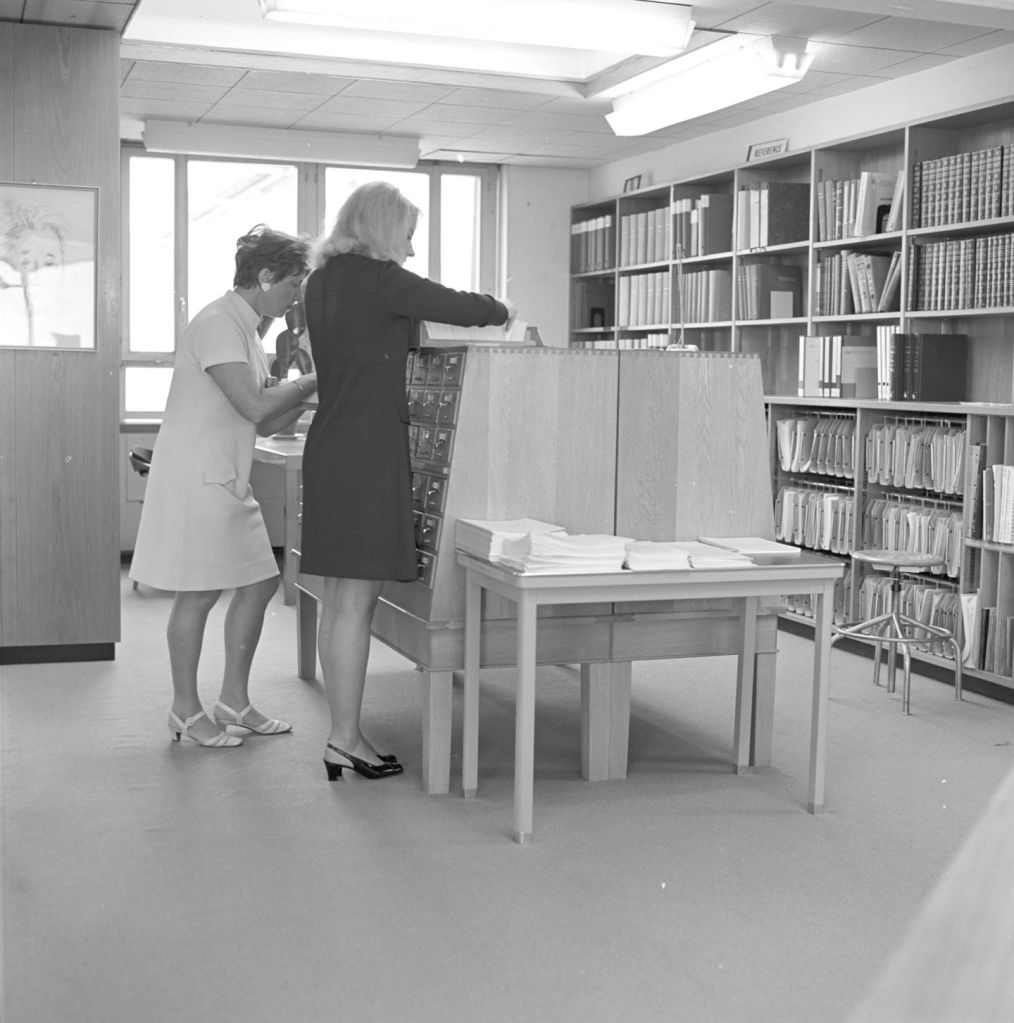
However, with the rising demand in preprints, the library at the Geneva laboratory, saw it as increasing necessary to perform some sort of screening of incoming preprints, simply to make the flood manageable. Accordingly, the library began to understand itself in terms of a gatekeeper of the preprint literature, although without appropriating for itself editorial qualities like journal editors. Instead, the 1965 CERN Library Staff Manual states: “The usefulness of a special library depends in large measure on its selectivity.” At the same time it warns that a “heterogeneous mass of vaguely related documentation can choke or crowd out the relevant and important items.”Library staff improved their handling of the newest accessions and were innovative in creating methods to handle papers, as the influx of preprints to the library grew and researchers’ information demands increased – essentially prefiguring the later moderation practices on preprint servers. These methods included the creation of simple classifications scheme to sort incoming papers, using subjects from the field of particle physics that were relevant to the work at the laboratory, and also determined in what order the newest preprints were put on display in the library reading room. At the CERN library, subject categories included “theoretical particle physics,” “high energy experimental physics,” “experimental techniques,” “detectors,” or “accelerators,” purely to enable the list to be sorted in a hierarchical order.3
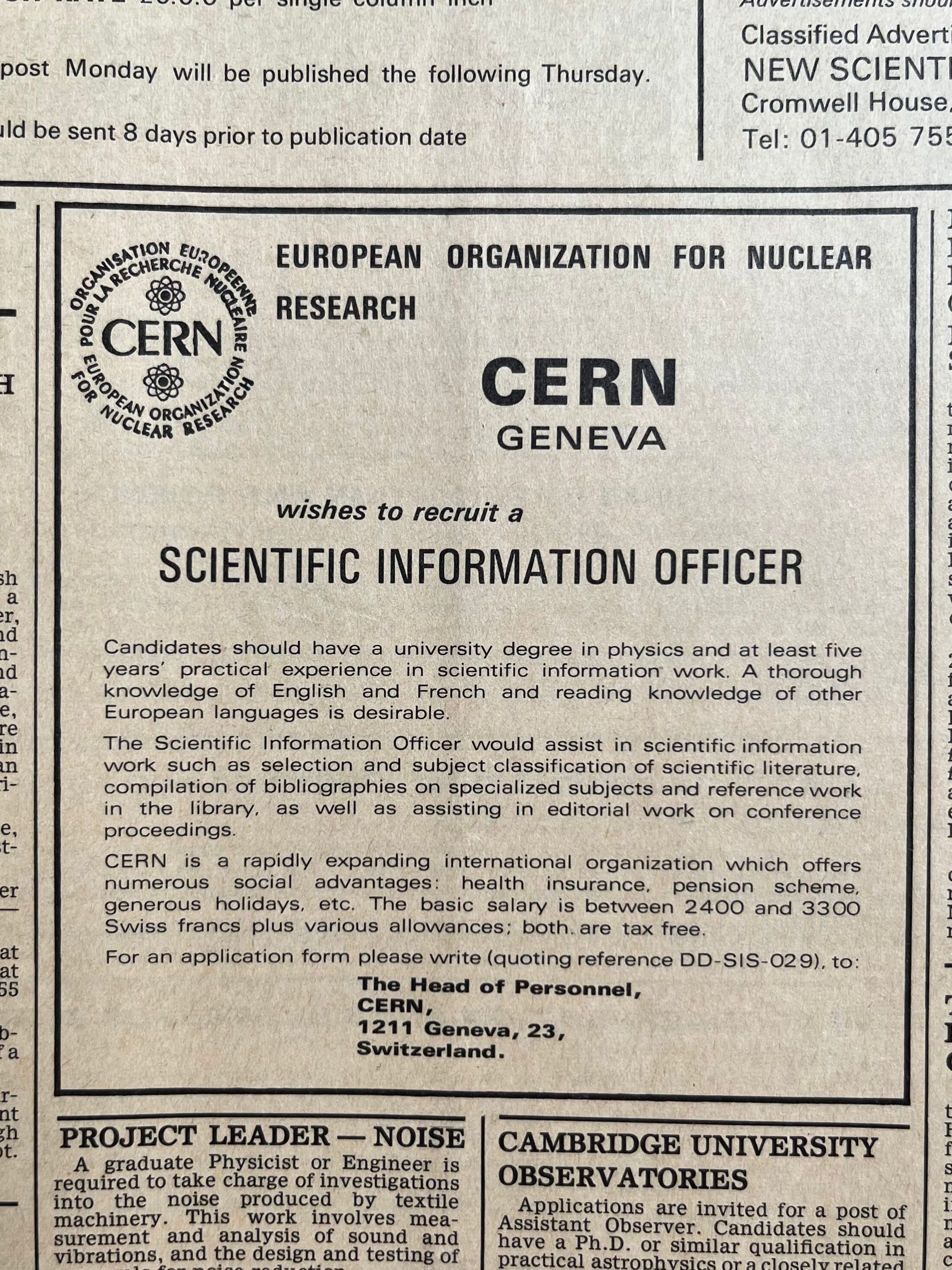
To meet up to their new tasks, libraries sought the aid of physicists in making their selections and helped innovative new methods to select and classify content. Libraries also employed “scientific information officers,”4 who occupied a specific role in the organization – usually people trained in both physics and librarianship, who had retired from active scientific research but remained in touch with recent developments in the field and therefore had the right sort of expertise to scan papers sent in and categorize them. In many ways, scientific information officers can be seen as precursors to moderators on preprint servers, as these also combine a certain familiarity with the work in their field and special practices of selectivity and classification. And also as with preprint moderation today, the library at CERN recognized early on that such forms of selection introduced “certain dangers”: the library manual admits, “the rejection of ‘border’ material is inevitably somewhat arbitrary.” There are no ‘objective’ criteria, which can determine what counts as useful information, and moderation seems to happen in a complex situation that brings together many different frames of valuation.
- An exception is Reyes-Galindo, L. Automating the Horae: Boundary-Work in the Age of Computers. Soc. Stud. Sci. 46(4), 586–606 (2016). ↩︎
- See Roth, P. H. Formalizing informal communication: an archaeology of the pre-web preprint infrastructure at CERN. Minerva (2026). ↩︎
- Ibid. ↩︎
- Roth, P.H. How libraries classified physics preprints before arXiv and set the stage for distinguishing insiders from outsiders. Nat Rev Phys 8, 188–189 (2026). ↩︎

